
When you are choosing a home with your child's primary school in mind, distance can become the deciding factor. Sometimes, it is the reason a family stretches its budget or gives up a home they otherwise love.
MOE's latest announcement gives parents a reason to revisit that decision.
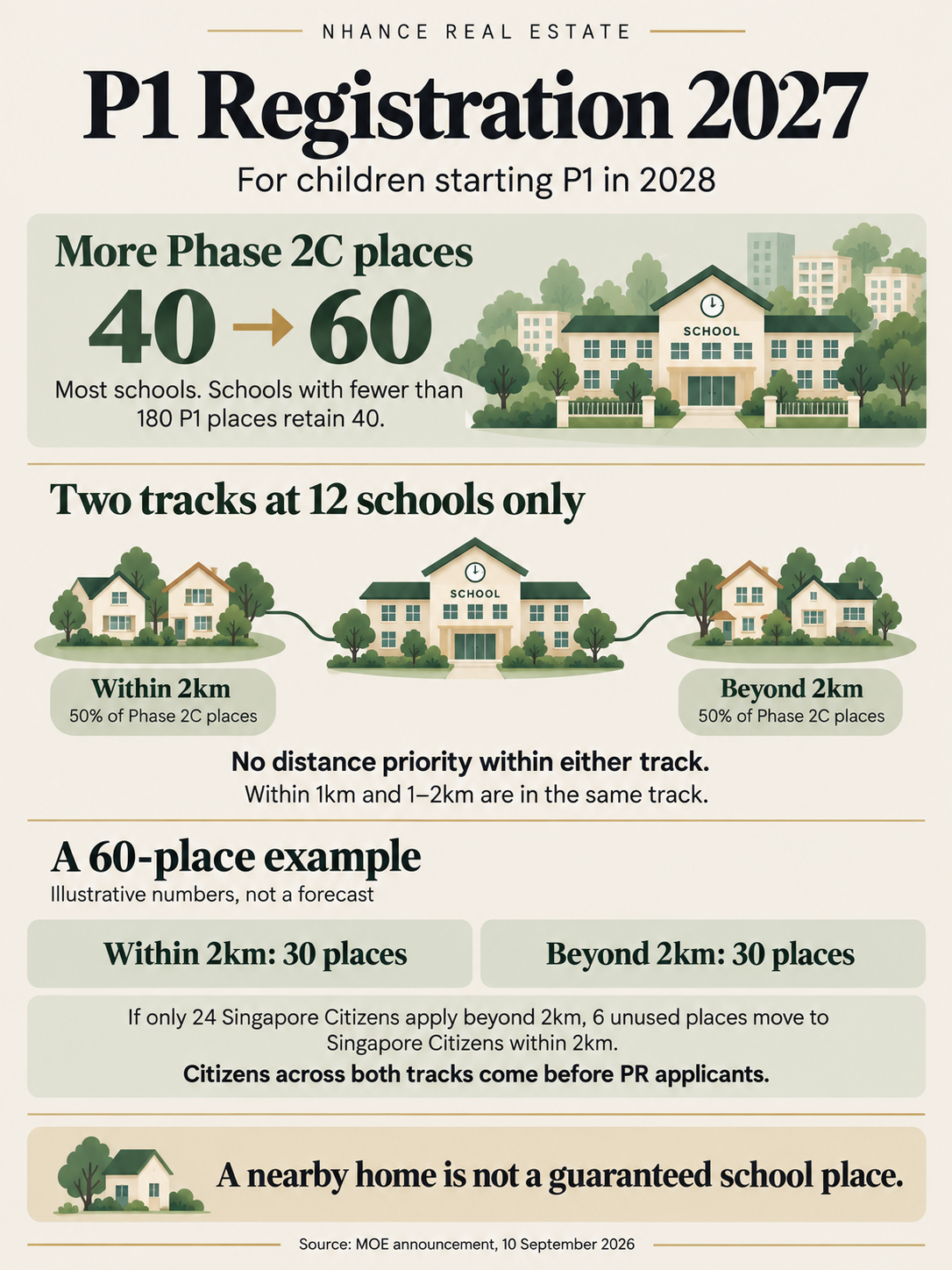
From the 2027 P1 Registration Exercise, for children starting Primary 1 in 2028, most schools will reserve more places for Phase 2C. Twelve schools will also introduce a new two-track arrangement. For those schools, living within 1km will no longer give a separate distance priority over living between 1km and 2km during Phase 2C.
That does not mean school proximity no longer matters. But it does change what you should check before paying more for a particular address. MOE announcement
What Is Changing?
1. More places reserved for Phase 2C
Most primary schools will reserve 60 places instead of 40 for Phase 2C. Smaller schools with a P1 intake below 180 will continue to reserve 40. Phase 2B will continue to have 20 reserved places.
This gives families without earlier-phase priority access to more reserved places. It does not guarantee admission to a particular school. Families eligible for earlier phases still have those opportunities before Phase 2C. MOE announcement, CNA's report
2. Two distance tracks at 12 schools
At the selected schools, the total available Phase 2C places will be divided equally between:
| Track | Home address | Initial allocation |
|---|---|---|
| Within 2km | Up to and including 2km from the school | Half of available Phase 2C places |
| Beyond 2km | More than 2km from the school | Half of available Phase 2C places |
There is no further distance priority within each track. An address 500m away and one 1.5km away fall into the same track.
The allocation is based on distance, not whether you live in an HDB flat, condominium or landed home. The beyond-2km track is not reserved exclusively for HDB households.
Also, the split applies to all available Phase 2C places, not just the reserved minimum. If there are 80 available places, the initial split is 40 and 40. If the total is odd, the extra place goes to the within-2km track. MOE announcement
3. Citizenship priority still matters
Singapore Citizen applicants across both tracks are considered before Permanent Resident applicants.
If one track has places left after admitting its Singapore Citizen applicants, those places go to Singapore Citizen applicants in the other track. Balloting is needed where demand exceeds the available places. Only after all Singapore Citizen applicants have been admitted are any remaining places divided between the two tracks for PR applicants.
So a PR applicant living very close to the school does not take priority over a Singapore Citizen applicant living beyond 2km under this scheme. MOE announcement
Which Schools Are Included?
The announced list comprises:
- Anglo-Chinese School (Junior)
- Anglo-Chinese School (Primary)
- CHIJ (Katong) Primary
- Methodist Girls' School (Primary)
- Nanyang Primary School
- Ngee Ann Primary School
- Pei Hwa Presbyterian Primary School
- Raffles Girls' Primary School
- Singapore Chinese Girls' Primary School
- St. Margaret's School (Primary)
- Tanjong Katong Primary School
- Tao Nan School
These are schools where public housing makes up less than 40% of dwelling units within 2km. MOE will review the list periodically. Do not apply this two-track rule to every primary school or every registration phase. MOE announcement and Annex A, school list reported by CNA
What Could This Mean for Your Family?
The following families, prices, distances and application numbers are hypothetical. They are not actual listings, client outcomes or admission forecasts. Unless stated otherwise, the examples concern Singapore Citizen children applying in Phase 2C to one of the 12 schools.
Scenario 1: A home 600m away versus one 1.7km away
A family is comparing two homes near Nanyang Primary School. One is 600m away. The other is 1.7km away.
Under the new arrangement, both addresses fall within the same Phase 2C track. The nearer home does not receive a separate within-1km distance priority.
There may still be good reasons to choose it: a shorter school run, grandparents nearby, or a layout that suits the family better. But paying more solely for a within-1km advantage in this particular phase would mean paying for a priority the new framework does not provide.
Scenario 2: How unused places can move between tracks
Suppose a participating school has 60 total available Phase 2C places. It initially allocates 30 to each track.
There are 50 Singapore Citizen applicants within 2km, but only 24 beyond 2km.
The 24 applicants beyond 2km can be admitted, leaving six unused places. Those six move to the within-2km track, giving its 50 applicants 36 places to ballot for.
The lesson: the initial 50:50 split is not necessarily the final allocation. Application numbers in both tracks matter. You cannot work out your child's chances from the distance alone.
Scenario 3: Staying in your current home 3.5km away
A family living 3.5km from Tao Nan School had been considering a move mainly to improve its Phase 2C position.
The new beyond-2km allocation gives them a reason to reassess that move. They can consider applying from their current address, although oversubscription can still lead to balloting.
Before deciding to stay, I would look at the practical side too. Who handles the morning journey? What happens after school? Are there suitable alternatives if the application is unsuccessful?
A school place is only one part of the plan. The daily routine still has to work.
Scenario 4: Is the more expensive home worth it?
Imagine Home A costs $2.4 million and sits 700m from a participating school. Home B costs $2.2 million and is 1.6km away.
Both fall into the same Phase 2C distance track. The $200,000 asking-price difference is not automatically a school premium: the homes may differ in size, tenure, condition and many other ways.
But this comparison gives the family a useful question: what are we getting for that extra $200,000, apart from being closer?
I would compare the homes on their own merits, check actual transactions, and work through the financing and cash buffer. The more expensive option might still be the right home. It should not be chosen on a mistaken assumption about admission priority.
Does This Mean Homes Near These Schools Will Lose Value?
The announcement alone does not tell us that.
A nearby home can still offer a shorter commute and access to amenities. Property values also depend on the unit, tenure, condition, supply and what buyers are actually willing to pay.
My view is that buyers and sellers should revisit the school-related part of their reasoning, not assume a particular price outcome. If you are selling, the case for your asking price should be supported by comparable transactions and the home's strengths. If you are buying, the property should still make sense if your child does not get into your first-choice school.
Before You Buy or Move, Check These Six Things
- Your child's entry year. These changes begin with registration in 2027 for P1 entry in 2028.
- Your registration phase. Do not assume a Phase 2C change describes your position in another phase.
- Whether the school is on the two-track list. Check the latest official list when you are planning.
- The exact address and distance. Use OneMap's School Query, not an agent's description or an estimated walking distance.
- Address eligibility and timing. Check MOE's prevailing address, residence and documentation requirements before committing to a purchase or tenancy. A planned move is not automatically an eligible registration address. Start with MOE's P1 registration portal.
- Your fallback plan. Consider other schools, the daily commute, your budget and whether you would still want the home without your preferred school place.
A Home That Works Beyond Registration Day
I understand why parents want to give their children more options. But a property decision should also leave your family comfortable with the monthly commitments, the moving timeline and everyday life after the move.
My role is to help you work through those choices with clarity. Sometimes moving makes sense. Sometimes staying where you are is the better decision.
If you are weighing up a move around primary school registration, book a free 45-minute Zoom consultation. We can look at your current home, financial position and timeline, then build a property roadmap around your family's goals.
WhatsApp Nicolette to arrange a consultation
Nicolette Ho | PropNex | Associate Group Director
CEA Registration No. R067180J
This article explains the announced framework and offers general property-planning considerations. It does not guarantee admission or future property performance. Always check MOE's latest requirements for your child's registration exercise.