Property Planning

The 15-Month Wait-Out Is Gone. Should You Sell Your HDB Now?
Nicolette HoAssociate Group Director, PropNex · 2 October 2026 · 7 min read
Now that the 15-month wait-out period has been removed, will HDB resale prices go up?
If you are thinking of selling and buying another home, there is a more useful question:
Will moving now put your family in a better position than waiting?
A higher selling price sounds good. Until the home you want to buy becomes even more expensive.
That is why I would not plan a property move around one policy announcement. I would look at both sides of the transaction, the money available, and where your family wants to be next.
The 15-month wait-out period was removed with immediate effect on 28 July 2026. Eligible private residential property owners and former owners can buy a non-subsidised HDB resale flat without serving that wait, provided they are not taking an HDB housing loan. HDB announcement; CNA's report of the announcement.
There are still conditions to check:
| Your intended purchase | What to check |
|---|---|
| A non-subsidised resale unclassified or Standard flat, without an HDB loan | The 15-month wait no longer applies. Other eligibility conditions remain. |
| You still own a private residential property | Disposal must generally be completed within six months of completing the HDB purchase. This includes overseas property interests. |
| A subsidised purchase, resale Plus or Prime flat, or HDB housing loan | The separate 30-month private-property wait-out requirement remains relevant. |
| A purchase using only the Proximity Housing Grant | Do not assume it follows the same rule as other grants. HDB lists this separately, subject to eligibility. |
These distinctions matter. Being eligible to buy a flat does not automatically mean you qualify for an HDB loan or every housing grant. Check your household's circumstances against HDB's eligibility conditions.
Removing the wait gives some private homeowners more flexibility to enter the resale market. That does not tell us how many will buy, when they will buy, or which homes they will choose.
My view is that the effect will differ between homes. A buyer looking for a spacious flat near family may not consider a smaller unit in another town, even if both are available at the same price.
For your home, I would look at recent comparable sales, competing listings, its remaining lease, condition and location. Then I would watch actual buyer responses, not assume a policy headline has added a premium.
There is another side to this: some sellers may list now, while others may hold out. The announcement alone cannot tell us how buyer demand and available supply will balance out.
The following figures are hypothetical, not market forecasts or client results.
Imagine your HDB could sell for $750,000 today. The condo you are considering costs $1.6 million.
You decide to wait for a better selling price. Later, your flat is worth 5% more, but the condo you want costs 8% more.
| Property / comparison | Today | Illustrative later position |
|---|---|---|
| HDB selling price | $750,000 | $787,500 |
| Condo purchase price | $1,600,000 | $1,728,000 |
| Difference between the two prices | $850,000 | $940,500 |
You receive $37,500 more for your flat. But the next home costs $128,000 more.
The price gap has widened by $90,500.
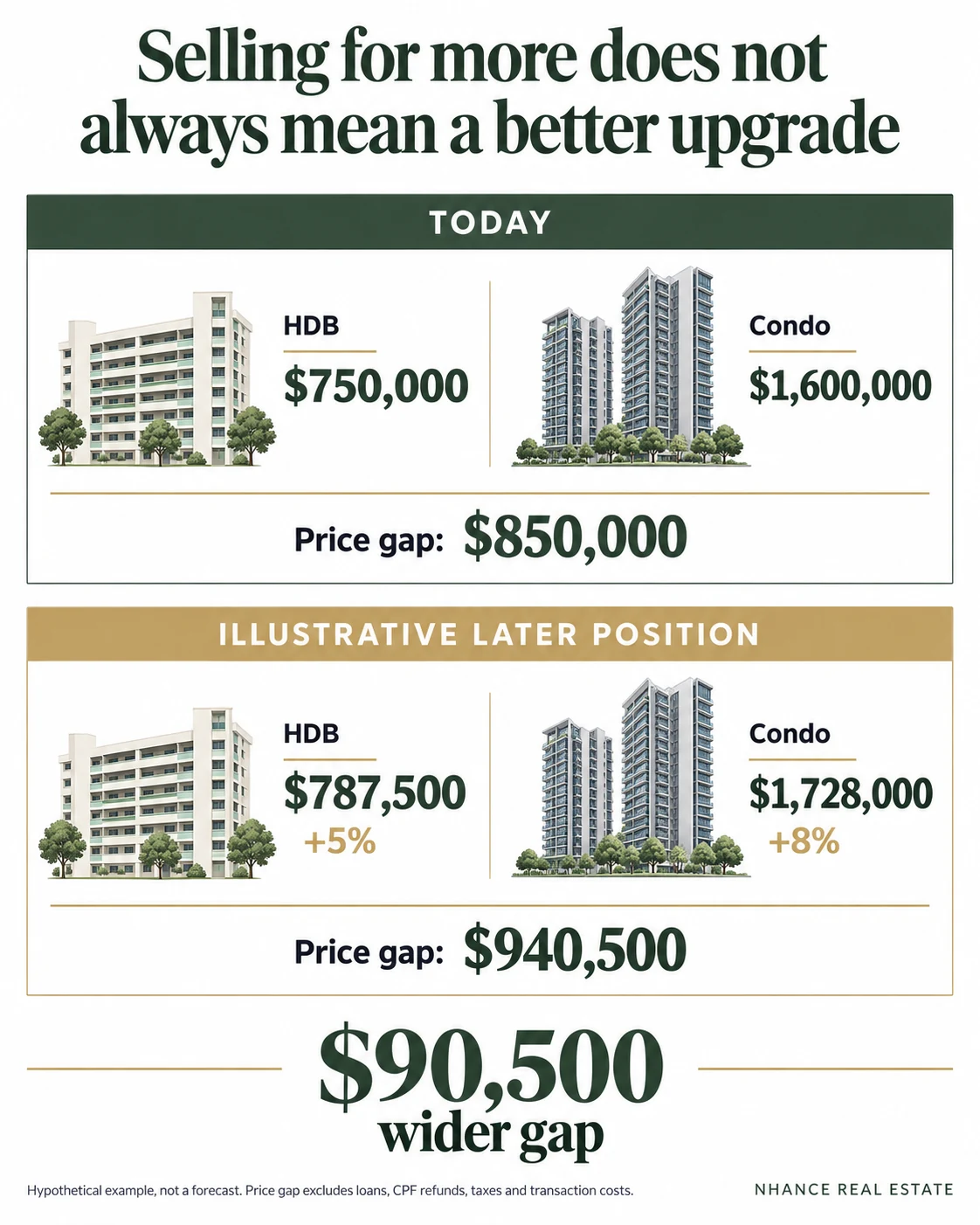
This is not your final cash requirement. It excludes your outstanding loan, CPF refunds, purchase financing, taxes and transaction costs. It simply shows why a better sale price does not necessarily mean a better overall move.
Even if both properties rose by the same percentage, the more expensive home would increase by more dollars.
This does not mean you should rush to upgrade. It means we should compare selling and buying together, rather than set a selling target without checking what comes next.
Consider a couple who want to reduce their housing commitments and move closer to their parents. They intend to buy an eligible non-subsidised resale flat without an HDB loan.
For a household previously subject to the wait, interim accommodation could have been a significant expense. At an assumed rent of $3,500 a month, 15 months would cost $52,500 in rent alone.
That is a budgeting illustration, not a rental quotation or a guaranteed saving. Removing the wait may reduce the need for a long rental period, but renovation, handover dates and the sequence of the sale and purchase can still create a housing gap.
I would work through four questions before they commit:
The change gives them more flexibility. A workable timeline is what turns that flexibility into a less stressful move.
Now consider an HDB owner whose repayments are comfortable, whose children are settled nearby, and who has no clear replacement home in mind.
Selling because there might be more buyers could create a new problem: finding somewhere suitable under time pressure.
For this household, staying may be the better decision. They can review their options without committing to a sale.
I would not recommend a move simply because a policy has changed. There should be a reason that matters to the family, whether that is space, location, lower debt, retirement planning or another specific goal.

Start with your reason for moving. What is not working in your current home? What would the next home need to improve?
Work out the funds available, not just the selling price. Separate the outstanding mortgage, CPF refunds, selling expenses and usable cash. Check the amount and timing of funds available for the next purchase with your lender, CPF Board and conveyancing lawyer.
Shortlist realistic replacement homes. Compare the actual properties you would buy, not an average market price. Include renovation and recurring costs in the budget.
Test the less comfortable outcome. What happens if your sale takes longer, your offer is lower than expected, or your borrowing capacity is smaller than you assumed? The plan should leave room for those possibilities.
Set the sequence before committing. HDB buyers need a valid HFE letter when the seller grants the Option to Purchase. Get eligibility and financing sorted early, then coordinate the sale, purchase and handover dates. HDB resale terms.
Don't optimise a single transaction. Optimise your entire property journey.
For me, that means looking beyond the price you can achieve today. Will the next home suit your family? Will the repayments be comfortable? Will you still have a financial buffer after moving?
The removal of the 15-month wait-out period creates options. It does not give every homeowner the same answer.
Thinking about selling, upgrading or moving from private property to HDB?
Book a free 45-minute Zoom consultation. We can review your current position, compare moving now with waiting, and map out a timeline that fits your goals.
WhatsApp Nicolette to book your consultation
General information, not an individual eligibility or financing assessment. HDB determines eligibility, and lenders assess financing. Recheck the prevailing requirements before committing. All scenarios above are illustrative.